
Dr. Seuss got bad press for racist stereotypes in some of his 1950s books, but don’t throw the beginning reader out with the bathwater.
© Ellen M. Shapiro
edited from the version published in March 2022 on Medium.com

TWO DR. SEUSS TITLES WERE ON THE WALL STREET JOURNAL’S BESTSELLING BOOKS list for the week of 2-19-22. Not on the children’s Hardcover Fiction list. But on the overall Hardcover Fiction list. Really? Yes. Green Eggs and Ham was number 6 and One Fish, Two Fish, Red Fish, Blue Fish was number 9. Both were new to the list.
Why? What happened?
I learned via googling that Dr. Seuss books had been panned, even banned in some circles, for racist imagery. News stories claimed that the cat of The Cat in The Hat, with his striped hat and bow tie, was based on (or if you’re feeling charitable, inspired by) characters in Black minstrel shows.
Uh-oh. As a creator of products designed to help children learn to read, I’d been a longtime champion of The Cat in The Hat as one of the most important books for beginning readers. It’s not only engaging and funny, it helps kids learn to read C-V-C words, three-letter words with a beginning consonant, a short vowel, and an ending consonant — words like cat and hat, sit and bit, man and fan, bed and red. Being able to read C-V-C words is the first step in “cracking the code” of the English language.
When children understand that alphabet letters are symbols that represent sounds, they’re on their way to reading.
It’s exciting to see kids grasp that when the initial consonant changes, the ‘at’ part stays the same. Aha! Suddenly, they can read a series of words including bat, fat, rat, mat, sat… and are inspired to want to learn more. When the vowel changes and the C-V-C word becomes bit, fit, hit, sit or wit, a whole new series of words is theirs. When they can decode the basic three-letter building blocks of written language, they are on the way to reading longer and more complex words, sentences, and soon, books.
When I googled “Dr. Seuss racist imagery” to try to figure out why the sales went up, I learned that sales rose dramatically as soon as the stories about racist imagery came out. That was really puzzling. Why? Did people want to see for themselves if the images were really racist in order to determine whether to buy his books and read them with their kids. Or, worse, do Americans just love laughing at racist imagery?
And if Dr. Seuss is truly a no-no, who or what will take his place? Many authors attempt to write “controlled vocabulary” books for very young or struggling readers, and they mostly fail, with such prose as: “Pat and the cat sat on the mat.”
Dr. Seuss, Theodor Seuss Geisel, 1904–1991, made the words ‘cat‘,’ ‘sat’ and ‘hat’ engaging and funny.
When the stories surfaced, I was ready to take The Cat in The Hat off the ‘recommended’ lists of books I publish to help teachers and parents teach reading.
But before doing so, I wanted to read the book carefully one last time, to find the objectionable illustrations I’d somehow missed. Were they really there—or were they like the mythical ice cubes with images of breasts in vodka ads? So I sat down and read The Cat in The Hat with my four-and-a-half-year-old niece. We enjoyed some big laughs. But we also talked about bothersome things in the story that don’t make sense in the real world—things that have nothing to do with racial stereotypes and minstrel shows.
My niece was eager to show me how many more words she could read than the first time we’d read it together. The book was helping her master something she’d told me just two weeks before that she didn’t know how to do, to read. She knows—and all little kids know, I hope—that Mother wouldn’t leave two young children alone in the house for a whole cold, wet day. Kids also know that fish don’t talk and that cats don’t balance on balls with rakes and cakes.
But neither of us could ignore the serious cultural problems inherent in the story.
Today, any mother who leaves two children alone all day would be visited by the Department of Children’s Services. In 1957, when the book was written, it wouldn’t have been cool either. And this mother left a cake with burning candles around? My, my. And the Cat—whether or not his costume and demeanor were derived from images of minstrel shows—just walks in? Mother didn’t even lock the door! All day, both children do nothing but watch the Cat’s antics with alarmed, open-mouthed surprise. It’s only the fish who objects. But when Mother is on her way home and it’s time to take action, it’s the boy, the unnamed narrator, who gets out the net and captures Thing One and Thing Two with a PLOP, while poor Sally just watches from behind a corner.
If the narrative isn’t racist, it surely is sexist.
Yes, the Cat comes back and cleans up the mess. And Mother will never know what happened.
Or will she?
I concluded that today’s kids are really, really smart and perceptive. They could get a good laugh at the comic situations and illustrations while improving their reading skills. And then even at age four-and-a-half—discuss the problems in the story.
Please don’t throw the baby (or beginning reader) out with the bathwater. If you do, a silly cat might not come along and mop up the mess.
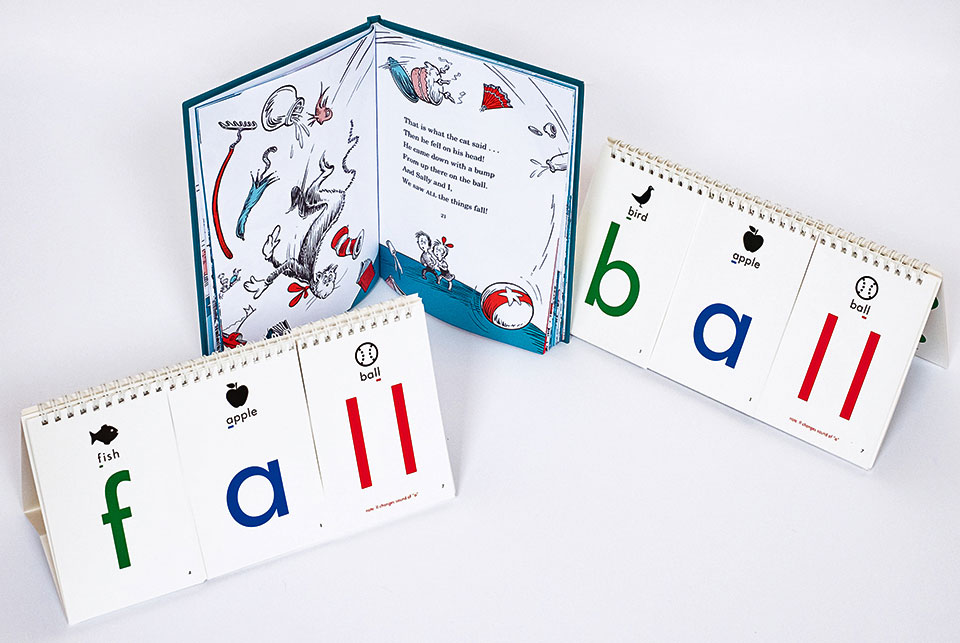
Note: The Is It a Word–Or Not? flip book is available on Amazon and on my Etsy shop. Learn more about it here.