Commissioned by BooksbyWomen.org

ISN’T THERE ENOUGH HOLOCAUST LITERATURE out there already? Why would I — or should you — add another book to the mix?
Well, there weren’t enough — or the right books — for my fifth- through seventh-graders in a synagogue Sunday school. The Holocaust wasn’t part of the curriculum, which focused on the positive aspects of Judaism. To those kids, it was a mysterious period involving gas chambers and the baddest of all bad guys, Hitler. Some of them knew that Anne Frank hid in an attic but still got taken to a death camp. They did need to know more, but they didn’t need chronicles of gruesome, terrifying imprisonment and death. That can come later. Instead, they needed an easy-to-read, illustrated book written from the point of view of kids their own age, a story about escaping to relative safety — like my mother did. A story about ultimately prevailing and entering young adulthood ready to contribute to a more just world.
The need is different for other children, in other circumstances. “The legacy of the Holocaust is an immediate reality for many of our families,” says Shoshana Jedwab, Middle School Jewish Life Coordinator at Abraham Joshua Heschel School in New York. “A significant portion of our students’ grandparents and great-grandparents were hunted and hidden during WWII or managed to escape the Nazis just before the gates closed. Many families are only one or two generations removed from an ancestor who narrowly avoided murder.” Heschel students study the Holocaust, Jedwab says, “and books like The Secret Buttons are crucial because they move history beyond the textbook into the lived experiences of young people.”
All of us need many, many more stories of all kinds. One reason is that everyone’s stories are different. My book was inspired by my mother’s memory of “crocheting around diamonds and making them into buttons for sweaters that refugees wore on boats to America.” Like my characters Anni and Rosie Blum, my mother got to England on a domestic servant visa, immigrated through Ellis Island, and successfully opened a needlework shop. Had the book been inspired by my grandparents — whose lives were cut in half into “before Hitler” and “after Hitler” — it would have been a much sadder story in which the characters cannot recover from their physical and psychological injuries. Of the books set in Europe at the outset of the Nazi regime, some take place in cosmopolitan cities like Anne Frank’s Amsterdam. Others take place in small villages where a few Jews could hide in nearby forests and barns. Anni and Rosie’s family lived in an apartment building in Vienna, the Nazis’ testing ground for their cruel innovations, such as getting — via false promises or at gunpoint — access to Jewish organizations’ membership lists so they could break down the door of apartment 4-B but bypass the “aryans” in 4-C.
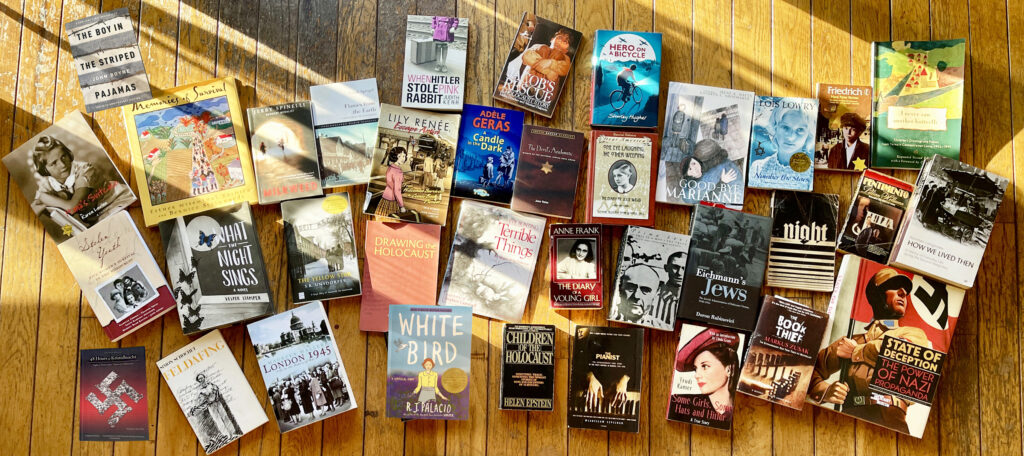
But what about stories in which the Jewish children are not passive victims? I couldn’t find a book like that. In some of the best and most popular titles, the main characters, the heroes, are not the Jews. The heroes are the most righteous of gentiles who put their own lives on the line to save Jews. In Number the Stars, the story focuses on brave Annemarie Johansen and her Christian family, especially brother-in-law Peter, who undertake a risky mission to save Annemarie’s best friend Ellen Rosen and her family. In R. J. Palacio’s graphic novel White Bird, a French boy keeps Jewish former schoolmate Sara hidden in a barn, fed and supplied with books. In The Boy in the Striped Pajamas, Bruno, the lonely son of the Auschwitz commandant, befriends Shmuel, the starving prisoner behind the fence, until the day Bruno dons a “striped pajama costume” himself to have one last chance to play with Shmuel before he and his mother and sister return to their beautiful home in Berlin.
“Jewish life should not be defined by victimhood, but by resilience and creative activism,” asserts Miriam Rubin, a musician based in Brooklyn, NY, who creates personalized Jewish rituals and events. I followed that advice when creating my characters. This is what you were born to accomplish, I told Anni and Rosie in my mind. Go forth and do it!
It isn’t easy devising a plot in which the antagonists are the Nazi regime and U.K. laws that forbade money or valuables from leaving the country during wartime. But with the help of research and interviews with people like a philatelist who knew how mail could get from Allied to Axis countries and a woman who came to America on a troop ship — my characters blossom from confused English-language learners into problem solvers. For them and their parents, to stay in their home country would have been a death sentence.
I hope The Secret Buttons — and the books you write — will inspire immigrants who’ve been strangers in a strange land, America, to prevail, to succeed. And inspire those of us born here who don’t need to escape war, terrorism, or poverty, to be grateful for the accomplishments of the millions of immigrants who’ve come here, the richness they bring us. And that none of us will stand idly by, like many Europeans did, and watch anyone be taken away.
“Appreciate immigrants as individual people with inherent dignity,” asserts Rev. Dianne Daniels, pastor of the Unitarian Universalist Congregation of Norwich, CT. “Just because people come from another country, city, neighborhood, or school, never treat them as less than you. The Secret Buttons is the kind of story we want to expose our children to. Read it. Talk with them about it. Write and publish more books like it. Pass along inspiration for change. Make a difference.”