
© Ellen M. Shapiro
Published in Communication Arts magazine #241, July 1993
Anthologized in Looking Closer2, Critical Writings on Graphic Design, edited by Michael Bierut, William Drenttel, Steven Heller, DK Holland, published by Allworth Press, 1997
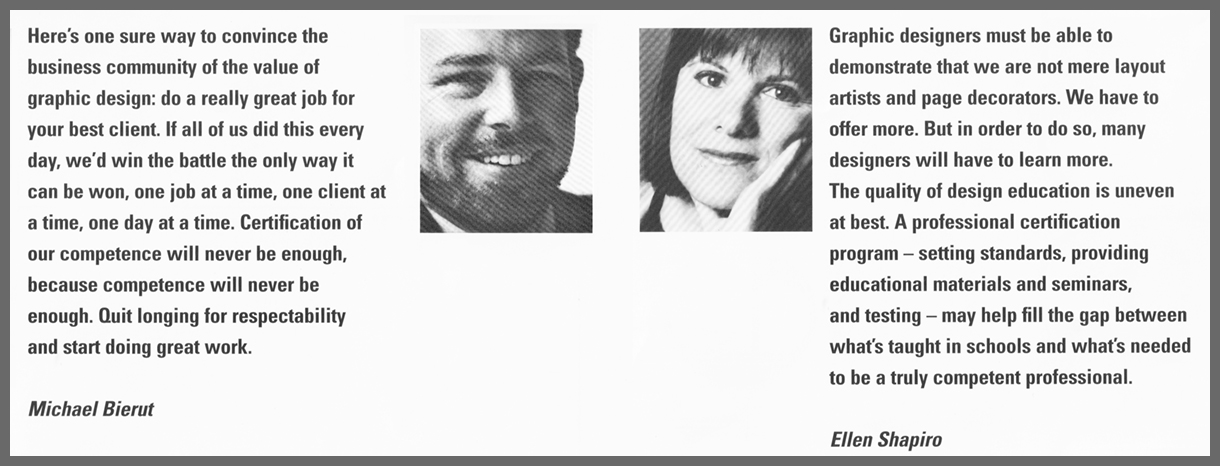
THE OTHER NIGHT I WAS STANDING IN LINE for a movie. The guy in front of me was talking with his date: “What d’ya do?” she asked. “I’m a graphic designer.
“J’learn that in school?”
“Nah, got a computer last summer and I’m learning as I go.”
Yeah, I thought, then I’m a nuclear physicist.
Somehow, at that moment — on a Saturday night when other things should have been on my mind — the words “accreditation” and “certification” popped into my head.
Those two words have been much bandied about the design community in recent years and are almost always accompanied by impassioned debate. An accredited educational program meets standards set by an official body, such as a state or governmental agency. An individual who is certified to practice a profession or trade at a particular level has or passed a test or otherwise proven that he or she is qualified.
Although most graphic designers seem to agree that since the advent of computers as design tools standards have fallen, or at least gotten fuzzy, they don’t know what to do about it. I recently polled a nationwide sampling of design firm principals and educators, and the results show that over 60 percent feel that there’s no accurate way to tell if a job candidate is really qualified — or for a client to tell if an independent designer really has the training and skills to manage a complex project.
Yet the idea of certification has continually been met with skepticism, if not outright dismissal. Jack Summerford, principal of Dallas-based Summerford Design, reports that when he joined the board of the American Institute of Graphic Arts (AIGA) two years ago, certification was brought up at every meeting, and the debate always ended the same way: no progress. Steve Liska, of Liska and Associates in Chicago, agrees that the myriad arguments pro and con have been “discussed a billion times,” and says he doubts that it can effectively happen.
Many designers, however, will complain that, “Every yoyo with a Mac who does a flyer for a bake sale think they’re a graphic designer.” There is a real fear that jobs are being lost to the new army of desktop publishers and para-designers, who have taken a layout course at an adult-education program. They will express some kind of longing for a solution. Then they will reflect for a moment on their fantasy of what the world would be like if we all had to prove our qualifications, most likely by taking a big stupid multiple-choice exam. And ultimately, of course, they will veto the idea.
Certification, a dumb idea.
No wonder. There are many good reasons why a certification program for graphic designers is a dumb idea.
- A test will be a royal pain to develop and administer.
- It will cost a lot of money.
- The profession is too functionally diverse to reach a common standard.
- No one wants more bureaucracy.
- Everybody hates tests.
- You can’t test for creativity, anyway.
- Some superb designers who’ve been in the business for years might do poorly, or even flunk.
- Some terrible designers will figure out how to pass.
- Certification could provide a veil of professionalism for the unscrupulous.
- The problem is really in the design schools, and it doesn’t make sense to go back and try to fix it this way.
- No one has been hurt or killed by a graphic design, yet.
Certification, a smart idea.
On the other hand, there is one reason why a certification program for graphic designers is a smart idea.
- We need it.
Ed Gold, professor in the Communication Design department at the University of Baltimore and author of The New Business of Graphic Design, maintains that the certification process will automatically raise professional standards. “We’ve been trying for years to convince clients that design does something valuable, but we’ve failed. Clients buy design because they have to; they can’t put out a product that isn’t designed, he says. But the decision is usually made on the basis of pure ego, pure taste. Nobody’s suggesting that people won’t look at portfolios and awards any more, but let’s at least have something they can use to judge who’s got the right skills.
Massimo Vignelli believes that people would work hard to meet the standards, and that clients who are interested in quality work would be more likely to hire certified designers, who might even be able to charge higher fees. “Certification is inevitable,” he said at last May’s AIGA Chapter Retreat, pointing out that at one time architects and physicians didn’t have professional standards either, and that “now is the time for us.”
I knew as little as you about this issue two years ago. And frankly, I cared even less. Then I was assigned an article on the subject, which appeared in The AIGA Journal (Volume 10, No 1.) as, “The Accreditation Debate: Give It Up or Give It a Try?” Since then, I’ve spoken to many colleagues as well as to representatives of the accreditation and certification bodies of the architecture, interior design, and business communications fields — our closest siblings. I conducted a poll of design firm principals and educators and led a rather messy discussion among 35 AIGA chapter representatives and board members. And I have come to the conclusion that even though all the reasons we shouldn’t do it have some merit, we need it.
Before you moan and groan and turn the page (or curse me for bringing up the subject), I want you to suspend your skepticism for a few moments. Let me walk you through a concept – perhaps a flight of fancy, perhaps an attainable goal — that I hope will make sense.
The Concept
The concept hits six major points. Read through them. Think about them. Think about what this could mean to the profession. Then share your thoughts. Use the survey at the end of this article to fax your response to CA magazine.
- Certification should be individual and voluntary.
- It should be granted to graphic designers on the basis of a combination of education, experience and testing.
- Adherence to a particular design style and personal taste should have nothing to do with it,
- Professional certification should determine whether an individual has attained the level of skills required to serve a client independently – or to open his or her own office.
- Certification must not depend upon membership in any organization, nor should membership automatically be granted upon certification.
- The test should be developed and administered by a neutral organization in concert with the nation’s leading graphic design associations.
Let’s look at each of these in detail:
Certification should be individual and voluntary. Unlike architects, who must be licensed by the states in which they practice in order to engage in their occupation, graphic designers will never be required to, pass a state licensing exam. Designer certification must be strictly voluntary. Career or business doing well? Satisfied boss and/or clients? Level of professional knowledge up to the task you are doing – or would like to do? No problem. No pressure. However, for those who want to learn more, to challenge themselves, move to the next level, measure themselves against the best, or for a host of other reasons attain certification, the opportunity should be there. If a program is administered correctly, the qualifications will be fair and comprehensive. And people will be interested in learning the material, meeting the standards, preparing for the test, making sure they’re ready to practice the profession in a serious way.
There are too many design-firm business failures. Dan Wefler, of Wefler & Associates in Evanston, Illinois, which publishes The Design Firm Directory, estimates that there are approximately 8,000 U.S. graphic design firms that work directly for clients. His educated guess — there are no accurate government statistics — is that ten percent of them go out of business in a typical non-recession year. Perhaps this happens because the principals open their own offices before they’re ready; they simply didn’t know what they needed to know in order to succeed.
Rather than viewing certification as a bureaucratic nightmare, it should be looked upon as an opportunity to learn everything you need to be a qualified professional; what you weren’t taught in school or that you didn’t have the opportunity to pick up on the job.
Ron Martin, vice president for employee communications at American Express Company and a past chairman of the International Association of Business Communicators (IABC), which has a well-established certification program says, “Certification means that you’re more than a narrow specialist. It means, here’s a well-rounded professional who can serve senior management.” Martin notes that many IABC candidates find that the learning that takes place when going through the process itself — taking professional development seminars and participating in informal study groups — is one of its key benefits.
Melanie Roher, principal of Roher Design, Inc. in Ardsley, NY, recalls a moment of truth in her career when she realized that she would have to improve her professional and project management skills. “I took a two-year entrepreneurial business course,” she says. “If I’d been working toward graphic design certification, I might have been able to avoid the trial–and–error route.”
It should be granted on the basis of a combination of education, experience and testing. Everybody knows a fabulous designer who majored in biology or who never graduated from college. Jilly Simons of Concrete, the Chicago design firm she heads, worries that she’d “hate to lose those great designers/thinkers/practitioners with no formal design education.” Not to worry. The mandate is to develop a program that makes sense for our profession, that reflects the way things really are. There need not be a formal education requirement, for example, for someone who can demonstrate professional competency through a portfolio or in other ways.
Likewise, everybody also knows someone with an MFA from a design school whom they think would have better success as anything but a designer. Just as professional standards in graphic design are all over the place, so are educational standards. Graphic design is taught primarily by oral tradition. College teachers impart what they know, with their own personal bias.
During my more than five years teaching both undergrad and graduate typography and corporate design courses at two leading NYC design schools, no one told me what my classes should cover, what was expected that graduates should know. I created my own curriculum as I went along — as many of colleagues do. And as design educator Ed Gold points out, graphic design is increasingly seen as a “cash cow” by lesser colleges who are cranking out graduates with minimal training by a not-very-talented faculty. According to one design educator, there are over 850 programs — from community colleges through universities that graduate many thousands of graphic design majors every year.
Given the unregulated and uneven nature of design education, a degree is not enough by itself. To assure true professionalism, a valid certification examination should be offered only to people who have practiced in the field for a specified number of years. Experience and a portfolio must be key ingredients. And because everyone’s professional experience is different, the test will most likely require exposure to and study of areas that one might not encounter in day-to-day work. If your boss doesn’t know anything about signage standards, information design, or SEC requirements for financial statements, chances are you won’t either. But studying for the exam would give all candidates a chance to expand their knowledge and very likely to prepare themselves for new or higher-level positions.
There is much to be learned from the standards required of interior designers. All U.S. and Canadian interior design organizations subscribe to the impressive testing program administered by the National Council for Interior Design Qualification (NCIDQ). To be eligible to take the test, an interior designer must have at least six years of combined educational and practical experience. This includes combinations such as: a four-year degree in interior design plus two years of professional experience; a two-year certificate plus four years of experience, etc. Based on a comprehensive survey of the graphic design field, we can devise our own realistic eligibility requirements.
Adherence to a particular design style and personal taste should have nothing to do with it.“If professional standards are regulated by licensing architects and interior designers, why do we still have so many ugly buildings and offices?” asks John DuFresne, principal of Pig’s Eye Design in St. Paul, MN. Like most of us, he questions whether an aptitude for aesthetics can be tested.
We shouldn’t even try. Whether you like hot pink or cool gray #3, Helvetica or Bernhard Modern, is up to you — and the employers or clients who hire you. The test must measure knowledge and skill, not taste. It’s not whether you favor certain colors, it’s whether you know how to specify color so that a printer understands your directions. It’s not which typefaces you prefer, it’s whether you can spec type accurately. A meaningful, valid test would ascertain if you have what it takes to handle a job from the moment you meet the client through supervising the delivery of the final product. The test must be a test of professional capabilities, not preferences or prejudices. But it should not be solely a production test. Far from it. It should test senior-level skills of problem-solving, analysis, organization of information, communication and presentation necessary to work with management to produce specific effects and achieve desired goals.
The NCIDQ test can be a paradigm for graphic design qualifications. An instructive 326-page book, Interior Design Reference Manual, reviews the subject matter and provides sample test questions, which range from multiple-choice, based on written information and graphic materials (“Which is the correct symbol for a duplex outlet?”) to written answers (“What are the most important questions you need to ask the client in such-and-such a situation in order to plan a small medical office?”). The candidate then has 2 1/2 hours to complete a “practicum/scenario,” that is, to develop and correctly draw an interior scheme that includes all required spaces, adjacencies, circulation, furniture groups, lighting. Whether the wallpaper is floral or striped — or there is no wallpaper specified at all — is irrelevant. The manual warns, “Remember that the jurors are not looking for award-winning, innovative solutions, just proof that you can respond to a program and integrate design principles and lighting into three-dimensional volume.” Several different solutions that would be given high marks are illustrated.
Imagine how this can be applied to graphic design. In my mind, the question is not what can we possibly put in a test for graphic designers, but what we will have to leave out. Do you understand the difference between process and flat color, the principles of typography, printing and bindery processes, paper grades and specifications, and on and on.
Michael Weymouth, of Weymouth Design, Inc., in Boston, can reel off a whole list of technical material he would like to see covered: When should you use short-grain paper, what constitutes a mailable envelope, should you reference coated or uncoated ink swatches for matte-coated stock. “I am very big on exploring the content,” he says. “I hate to see things done wrong, like a double-saddle-wire job that’s bound wrong, with a big gap in the middle.”
Professional certification should determine whether an individual has attained the level of skills required to serve a client independently–or to open his or her own office. The design firm principals I asked tend to agree that it’s difficult to tell from a portfolio whether a candidate is truly qualified for a job. They rely on resumes, interviews, chemistry, and especially on references. Many report that they’re only too aware that plenty of good-looking stuff in portfolios was done by a supervisor, perhaps the art director, or was the result of a group effort — and that dishonest references have helped many unqualified people get jobs from which they had to be fired.
Joe Feigenbaurn, of The Design Office, Inc., in Irvington, NY, says, “I’ve seen some ‘great’ portfolios where ‘the designer’ basically completed mechanical production.” Feigenbaum thinks the most valuable benefit of certification might be encouraging design schools to offer more complete curricula and forcing lesser schools to improve or disband their programs.
Steve Liska adds, “Schools graduate designers who can’t conceptualize, problem-solve or functionally do much.” He suggests that if an accredited core curriculum were developed to teach a broad spectrum of craft and concept, our industry would be healthier. “It would appear that the whole issue is a reflection of our disappointment in our education system and the students it produces,” adds Kenneth Cooke, executive vice president and creative director at Siegel & Gale in New York, who opines that if schools were accredited it would, “help separate the cosmetics from the knowledge.”
To assist in hiring, a brief entry-level or junior designer test could be developed to be administered in the office during interview situations. This would be a helpful tool for employers and could serve as a guide for design schools which – in the hopes of producing better-qualified graduates – might endeavor to add the content to their curricula.
However, the type of professional certification I’m proposing here is something quite different indeed. It is intended to determine whether an individual has attained the level of skills required to serve a client independently and without supervision — or to open his or her own office. If it’s difficult for design firm principals who’ve worked in this business for an average of twenty years to tell if someone is really qualified, imagine how it is for clients. And they’re the ones we should be concerned about. They want to know that you — the designer — know what you’re doing, that you’re not a flake, that the thousands of dollars they’re investing in a project are going to be managed properly from start to finish.
Four areas should be covered: design theory and history, the design process itself (problem solving and visual communication), professional and business practices, and production. Kenneth Cooke, who recognizes that “a creative idea from the mind of a non-certified designer is worth more to a client than a pedestrian idea from a merely competent but certified designer,” has developed a detailed list, a body of knowledge that he believes every senior or practicing designer should have mastered and it also includes marketing, client relations, and environmental responsibility.
All this cannot be learned in school. Some of it is not academic material, it is professional, on-the-job material. Like many of my colleagues who teach, I believe that design school is the place to get a good foundation in theory, then to experiment, to solve crazy, impractical problems, to not be constrained by the realities of the business world. Wouldn’t it be awful if during those precious four years of learning the liberal arts and art history and taking design theory and studio classes, you had to sit through lectures on contracts and proposals? Although good business practices can — and should — be introduced, perhaps in a senior-year portfolio class or a graduate-level seminar, in reality they’re only learned through experience, years of experience. I’ve owned and managed my own business for more than 15 years and I’m still learning. But how I wish I had had the opportunity to prepare for a certification program like the one described here before I opened my first office. What mistakes and calamities could have been avoided!
The IABC test, as an example, makes the assumption that you will be serving senior corporate management at the highest levels. The oral portion of the examination asks, “How would you advise the CEO to proceed with a communications program in such-and-such a crisis situation?” The NCIDQ test makes the assumption that you, the interior designer, will get this commission: a restaurant, a neonatal intensive care unit, retail shop, building lobby. And you will do it all by yourself. You will have no boss watching over your shoulder, no team to cover for your deficiencies. It will be done correctly, to the client’s satisfaction, meeting all programming requirements, documents in order, construction supervised properly.
As a graphic designer — whether you work at a corporation or a design office or head your own firm — only when you can demonstrate the ability to earn that level of trust should you be able to put the initials that indicate professional certification (whatever initials they turn out to be) after your name. Like other certified professionals, you would have to apply, submit a portfolio (not to be judged on taste and style criteria) and take oral and written examinations that would be offered on a quarterly or bi-annual basis in selected cities around the country.
Will there be economic benefits to certification? The design firm principals I spoke with were equally divided on the question of, “Will certified designers be able to charge higher fees?” 50 percent said no and 50 percent maybe. However, some people do see a distinct advantage. “I do look at it from a competitive point of view,” says Mike Weymouth. “At a certain level you want people who aren’t qualified to be weeded out. You want to have the edge on them.”
What do clients think about certification? I spoke to about half a dozen experienced design buyers, and to report that they’re keen on the idea is an understatement. Once they understand the concept, which admittedly takes some explaining, they love it. They say — with the caveat that the credentials must be genuine, not awarded to unqualified people and not passed off as a substitute for talent — that it would really make a difference.
“If there were a directory of certified designers, I would limit the people I work with to that group,” vows Jane Shannon, manager of human resources communications for Citibank, the global financial services giant. “Business people tend to romanticize designers, as in, ‘they’re artistes, they don’t really do this for a living,’” Shannon notes. “Certification might raise respect for the profession and help put an end to unethical practices like asking five designers to come up with ideas and then giving the best one to the in-house guy.”
Mary Durkin, manager of creative services at Big Six accounting firm Deloitte & Touche in Wilton, CT, reviews over 50 portfolios a year and works with six or seven design firms at a time. She says that recent proliferation of desktop people who are unqualified to function as project designers has been driving her crazy. “You can’t say everyone who’s a board-certified surgeon is an equally good doctor, but it sure gives you a field from which to choose,” she states. “There’s so much involved in designing something, even if it’s a one-page flyer, and people underestimate the knowledge and the skill that’s required.” Durkin says that if she had to make a decision between two portfolios of equal quality, she would definitely choose the certified designer.
In Philadelphia, at The Institute at Pennsylvania Hospital, Jane Friedman Century, assistant director of marketing services, who was trained as a designer and is now responsible for working with designers on a range of publications, says that the business community needs help. “Your basic business person doesn’t know a font from a food chain,” she remarks, noting that she would probably choose certified designers because she’d be more confident that they’d have more business savvy and wouldn’t operate “purely from the gut.” Century believes that keeping up the certification entitlement through continuing education should be an intrinsic part of the program.
“Everybody’s so cost-conscious these days,” notes Citibank’s Shannon. “It would be great to have two levels of certification, more junior and more senior, so that we could choose the level appropriate to the project.”
Certification must not depend upon membership in any organization, nor should membership automatically be granted upon certification. If you’re with me this far, you’re probably wondering, who’s going to do all this? Association Management magazine cites 151 national, state and local organizations that have education and certification programs for their members, beginning with Alabama Concrete Industries Association and ending with Wyoming Trucking Association. Forget it! I am opposed to any requirement that is dependent on membership in a particular organization. Sure, an association can, if it chooses, set up self-serving, hollow qualifications and try to make sure all its members pass. Many organizations initiate a “grandfather” clause, which means that all current members are automatically certified on the day the program goes into effect. But what value would that have? Would clients have to wait until the current generation dies off to have a meaningful situation? And, like the International Association of Business Communicators, whose accreditation program is otherwise admirable, some organizations require that “successful candidates retain their accreditation as long as they are members and continue to pay the annual maintenance fee.”
There are a couple of good reasons why graphic designer certification must not depend upon any particular affiliation. First of all the Federal Trade Commission (FTC) will not approve a certification program that requires nonmembers to join an association before they are allowed to seek certification. Secondly, the AIGA, the oft-cited example of the “right” organization to do this for us, is a national nonprofit organization that promotes excellence in graphic design — as an art, as a profession. If the AIGA got into the business of saying yea or nay to the qualifications of individual members, that could very likely hinder its mission. Chris Jenkins, an associate director at AIGA national headquarters in New York, explains, “Although we are studying the appropriateness and feasibility of developing a certification program, our mission is to promote the field of graphic design, not to promote individual designers.”
And if certification were granted to members of one graphic design association or another, what about the photographers, and illustrators who are members? Would they be granted different status? Could they no longer join? Quite simply, granting certification would be a tricky business for a design organization to be in.
The test should be developed and administered by a neutral organization in concert with the nation’s leading graphic design organizations. Seven design organizations are represented in the National Council for Interior Design Qualification. These include the American Society of Interior Designers (ASID), the Institute of Business Designers (IBD), Interior Design Educators Council (IDEC), and so forth. All assist in conjunction with the Educational Testing Service in Princeton, NJ, with the development and constant update and revision of the NCIDQ’s tests. All participate in the review of education and practice requirements, research, surveys, analysis, question development, grading, and jury procedures.
Does that make sense for the graphic design profession? Why not, as a start, invite the AIGA, American Center for Design, Design Management Institute, Corporate Design Foundation, Graphic Artists Guild, and perhaps the International Council of Graphic Design Associations (ICOGRADA) to form a similar alliance and create a certification board. Representatives of each organization, in concert with each other and with a panel of design educators and practicing designers, could compose the basic outline and procedures, amass the funding, and oversee the inception of the program. Rather than grant acceptance to — or reject — individual members, these organizations could use their expertise to advise, define, guide, set and update standards to ensure that the program is developed and administered in the best interests of the entire profession and all its practitioners.
Loren Swick, executive vice president of the NCIDQ, says that the interior design profession is as broad and diverse as graphic design, and that developing its program –it was founded in 1972 – was a daunting challenge. “But that now the research and results speak for themselves.” He acknowledges that in the early days there was skepticism among interior designers, too. “People don’t like to subject themselves to rigor and to possible failure,” he says, “but when you have a benchmark to measure yourself against, a standard to rise to, it all pays off.”
What do YOU think?
It’s time for me to stop writing and start listening. I welcome your comments. If you would like to have an input in the thinking behind the inception of any program that might be considered or developed, please fax your response to Communication Arts.
Note:
This essay sparked a huge debate, many more articles, masters’ theses, and discussions in design offices and in the boardrooms of design organizations around the world. AIGA Leadership was totally opposed to any certification program. Canada’s RGC (Registered Graphic Designer) program, to the best of my knowledge, is the only successful program worldwide. The debate in the U.S. culminated at what was basically the “Ellen Shapiro v. Michael Bierut” debate on January 23, 1995, at a packed ballroom in a Washington DC area hotel. Michael — with his charm and assertion that “the way to convince the business community of the value of design is to do a really great job for your best client” — won. What ultimately happened? Fast-forward to today. 1993’s focus on designing for print seems quaint at best. And what does “fax your response“ mean, anyway? The AIGA has developed and is currently promoting its own Professional Design Certification program for $1,389.00 with three add-on certificates ranging from $499 to $799. Certification is a thing, a trend. Now designers can’t spend more than ten minutes scrolling through social media to get a zillion invitations to programs, classes, seminars — everything from Hubspot Certification, to the Learn from Domestika series, to links to $1.99 tutorials by “expert professionals.” Besides, isn’t A.I. going to be doing everything anyway?